Regulator record
Every rating and finding from the Care Quality Commission, area by area, and exactly how old each one is.
- The five ratings, with dates
- What inspectors praised and flagged
- Who the rating was earned under
What’s inside
Every dossier follows the same order: the answer first, then the evidence, then what we could not confirm, then what to ask.
Every rating and finding from the Care Quality Commission, area by area, and exactly how old each one is.
The company behind the name: who owns it, how long they have, and what the filed accounts show.
What it is registered to do, who for, and which parts are inspected. In supported living, the housing is not.
The food hygiene rating for the kitchen, when it was awarded, and what the three sub-scores were.
What is recorded around the address: street-level crime over the past year and river or sea flood risk.
Seven questions for your visit, each one written from a finding or a gap in this home’s own record.
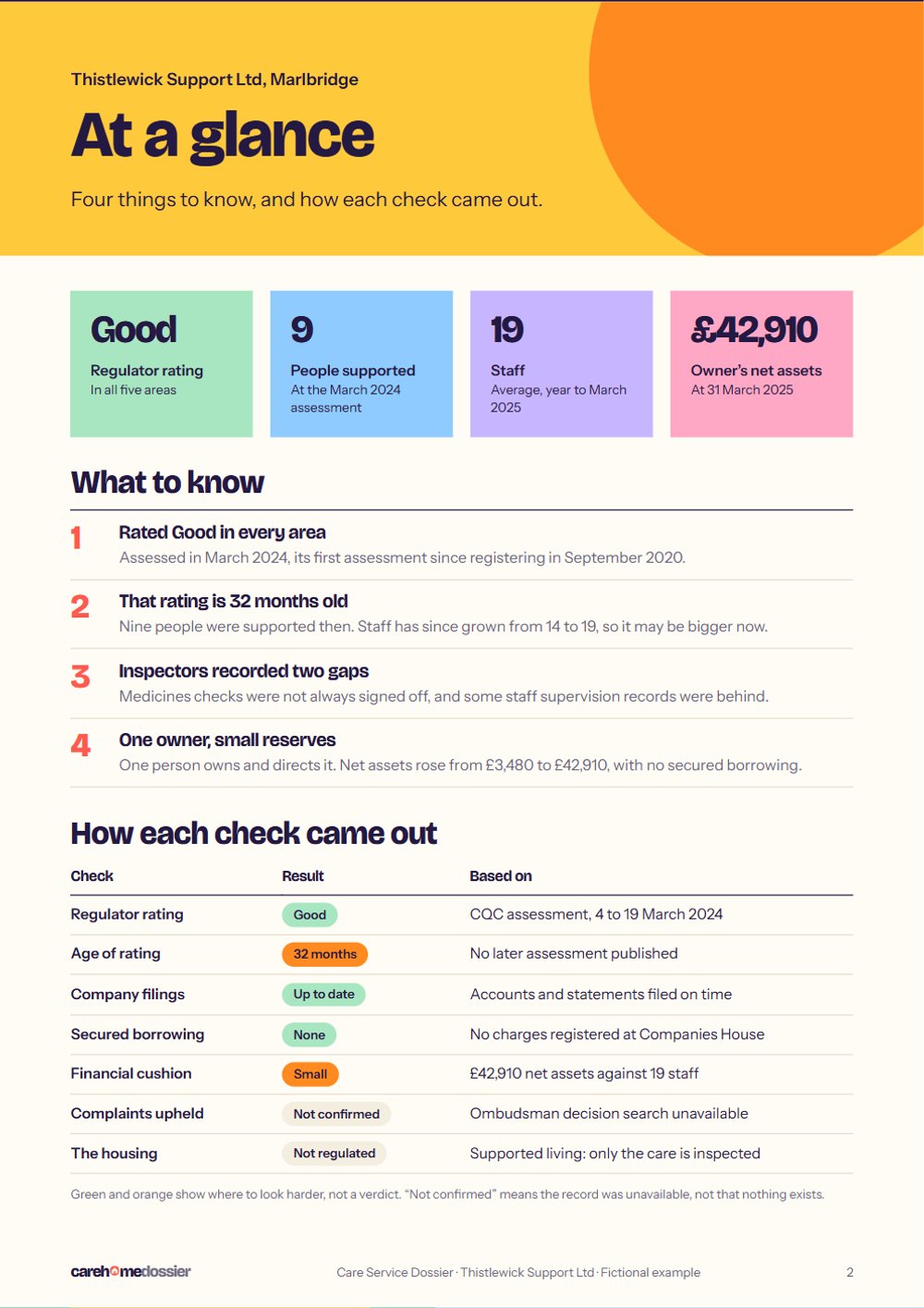
Page two
The rating, and the three figures that put it in context.
Numbered, in order of how much they should change your thinking.
Green is clear, orange is somewhere to look harder, grey is not confirmed.
How it is made
We match it across registers by postcode and name, so “Wells House” and “Well House” end up as one record.
At the moment you pay, not from a stale copy. Each check either lights a window or says why it could not.
Figures are copied from the register, never estimated. The wording follows fixed rules: no verdicts, a date on every fact.
Our one rule
Not for listings, not for leads, not for a better write-up. You pay for the dossier, so the dossier works for you.
Many care directories are paid when someone moves in. We are not, by anyone.
Every service gets the same page, built the same way from the same registers.
Providers can correct a fact or add a response. They cannot pay to change a word.
A dossier tells you what the record says. Only a visit tells you how it feels. We give you the questions to take with you.